
Pitfalls #4 – Discharge turbulence
Installation: the diffuser, the blind spot of system design
A discharge diffuser is a component that is often overlooked at the design stage
— and rarely regretted until the moment the installation fails to perform.
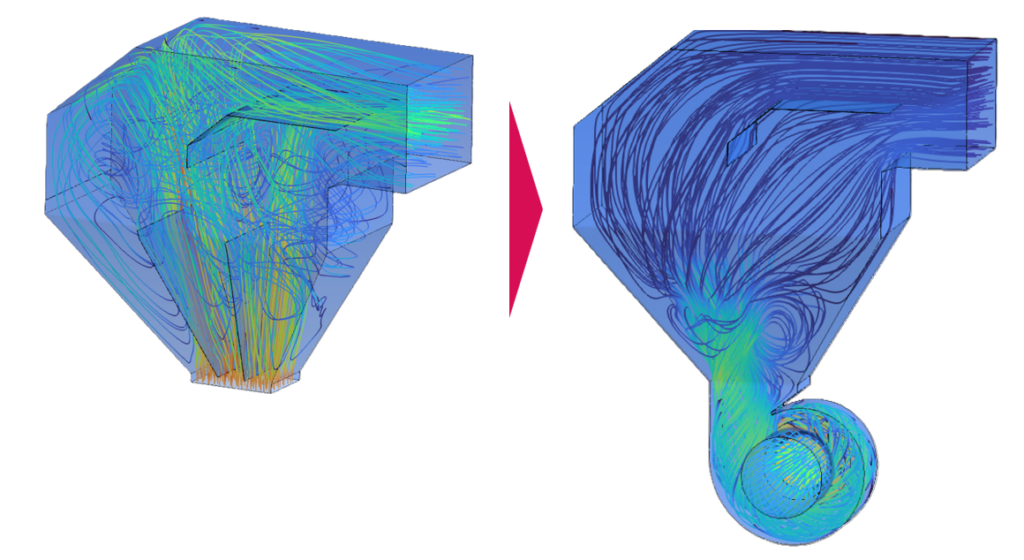
That is exactly the problem we encountered on an industrial site : a heat exchange battery placed downstream of a centrifugal fan, with an intermediate diffuser fitted with internal splitter plates. On paper, these plates were meant to guide and homogenise the airflow. In practice, they generated turbulence. Air concentrated on one portion of the battery and bypassed the rest. Skewed measurements, heat exchange efficiency below expectations.
What is often forgotten about centrifugal fan discharge
At the volute outlet, the flow is directional, asymmetric, and carries rotational components. The role of a diffuser is to redistribute this velocity profile across the full cross-section before the next element — battery, silencer, or otherwise. But a poorly designed diffuser does not redistribute : it disrupts.
The CFD simulations carried out in this case (see illustrations) clearly demonstrate the phenomenon. Removing the splitter plates proved more effective than keeping them in part. The correct solution would have been to reposition the battery so that the flow direction change occurred first, followed by diffusion — but the available space no longer allowed this once the installation was in place.
The pitfall: stopping at equipment selection
The fan was correct. The battery was correct. It was their sequencing, and the geometry of the connecting piece, that had not been sufficiently thought through from the outset. This type of error is difficult to correct after installation — and costly to ignore.
If you have any doubts about diffuser design or the installation sequence of your equipment, that is the right question to ask before commissioning, not after.