
Pitfalls #2 – Multi-Machine & Acoustics
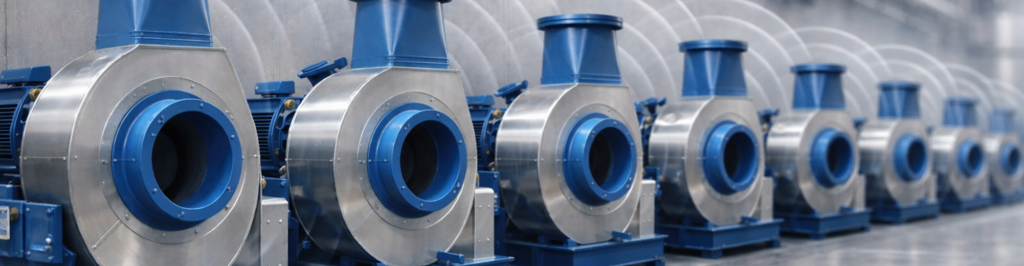
Multi-Machine Installations & Acoustics: Beware of Cumulative Effects
“But each machine is rated at 85 dB(A)…”
This is a common comment when the overall noise level of an installation exceeds expectations.
Individually, each fan complies with its specification — typically measured at 1 meter in free-field conditions.
Collectively, however, the installation may become too noisy.
Why?
Because in acoustics, sound levels do not add up linearly.
They combine logarithmically — and that makes a significant difference.
The classic pitfall: comparing isolated values
In multi-machine projects, the reasoning often goes like this:
- Fan A: 85 dB(A) at 1 m
- Fan B: 85 dB(A) at 1 m
- Fan C: 85 dB(A) at 1 m
The intuitive conclusion: we remain close to 85 dB(A).
In reality:
Two identical 85 dB(A) sources result in about 88 dB(A)
Three sources approach 90 dB(A)
Each additional source increases the overall sound level.
And even this remains a simplified view…
Distance and environment make a major difference
Published noise values are generally measured:
- At 1 meter
- In free-field conditions
- Without obstacles
In real installations:
- Machines are positioned close to each other
- Walls reflect sound
- Ductwork transmits noise
- Steel structures can radiate vibration
The surrounding environment can locally amplify sound levels far beyond theoretical values.
👉 In industrial acoustics, thinking per machine and relying solely on catalog values is a mistake.
Key takeaway
In multi-machine configurations:
- Sound levels combine logarithmically
- Distance strongly affects perceived sound pressure
- The environment can significantly amplify the effect
Most acoustic overruns are not caused by a “noisy fan,”
but by the absence of a system-level analysis during the design phase.